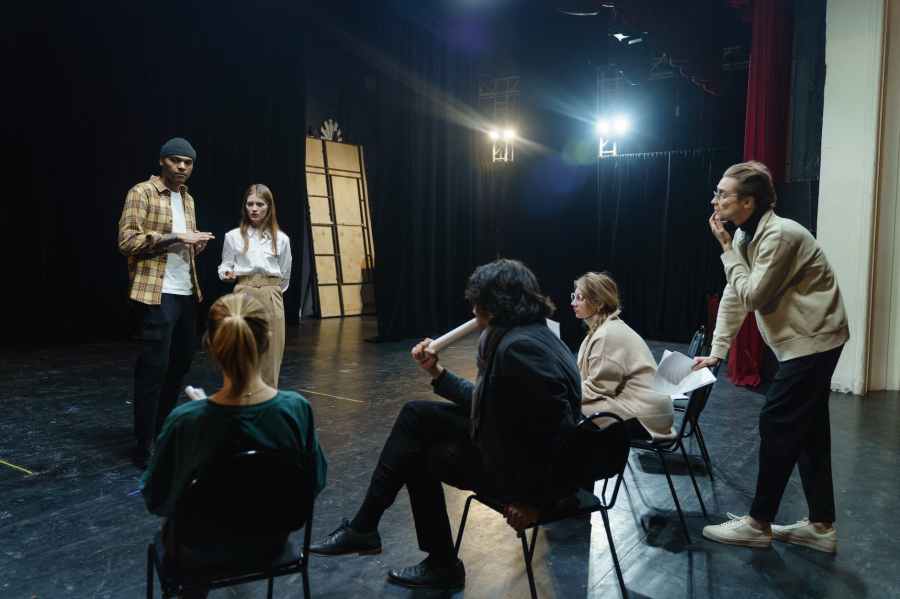
“Role-playing” is what many in the hobby call social interaction encounters. I consider any decision a player makes in the course of a game to be “role-playing.” The whole thing is role-playing. Combat, exploration, social interaction; it’s all role-playing. You are playing the role of your character in a situation.
Talking to other players or the game master in character, is a social encounter or social interaction.
I’ve experienced a few truly horrendous social encounters both as a player and as a game master. By the time they were over, I was bored, frustrated, irritated, or even angry.
It took me a while but I figured out why they sucked so much.
All the terrible social encounters I’ve ever experienced occurred when the player(s), the game master or both were trying to be a the center of attention to the exclusion of all other purposes.
Their “role-playing” had a selfish purpose. The player or players engaged in the conversation were completely focused on their own amusement. Nothing was achieved during the encounter other than a performance.
The basic requirements for any kind of encounter are objectives and obstacles.
The adventurers want to get the the other side of a bridge. A knight in arrayed in black stands in the way. On the other side of a trap is a treasure.
The characters achieve their objective, fail in their objective, or have a partial success. If none of those things occur, then it’s not a very good encounter.
Social encounters have the same requirement. The players have an objective. A player character talks to a non-player character because they want something. The player chooses the words they say, what they offer the NPC, or some other behavior. The referee determines the outcome based on the game’s rules or makes a ruling if no rule exists or applies.
Information is gained. A relationship with a merchant is damaged. The players learn of an adventure location. The NPC give the party a clue.
A social encounter that does not have a goal and impediment is pointless. They are also boring.
How not to play a social encounter.
The worst social encounters happen when two players are arguing with each other using funny voices merely to display the personality of the character. I’ve rarely seen this done in a way that was entertaining.
Usually, both parties suffer from Dunning-Kruger effect. They are terrible improvisational actors and think they are far more entertaining than they actually are to anyone at the table but themselves.
I played in a East Texas University Savage Worlds game that had this problem. We played college students discovering cosmic horrors. Two of the characters had taken a job at an antique store. One player was playing an entitled, basic, suburban white girl with a delicate sensibility, offended by everything. Such characters are no less annoying in a game than they are in real life.
The PC kept complaining about how the other PC was trying to do the job they had been assigned to do by the shopkeeper. This resulted in an argument between both characters that stretched on for about 30 minutes. Not only was this terrible to watch and listen to, the characters didn’t accomplish what they were trying to accomplish in the shop. I stopped playing in that game after that session. I thought about leaving during a break. I hoped it would get better. It didn’t.
Some folks enjoy having a lot of in character conversations. That can lead to some great game moments if you keep a few practices in mind.
Have a purpose.
Every social interaction encounter needs an objective. If you are talking to another PC in character, that conversation needs a purpose besides making a spectacle. Something should be decided. Information should be revealed. At the beginning of the encounter the game is one state. At the end of the encounter the game state should change. If it doesn’t then you’ve done nothing useful.
If you are talking in character and advancing the objectives of the entire group while you are doing it, that’s fantastic. Everyone will be on board for that. You can play a haughty and disagreeable sorceress, as long as she also successfully negotiates with the demon to ferry the party across the lake of fire and it doesn’t take 30 minutes to play through the encounter.
If your performance stops forward motion toward party objectives, most everyone else at the table is going to be irritated.
The difference between written dialogue and improvised dialogue.
Movie audiences are no more interested in pointless dialogue than players at the table. Most writers will tell you dialogue is one of the hardest skill to master in storytelling.
Great writers labor over every word of dialogue. They rewrite and revise many times.
In a game, we are improvising dialogue. We aren’t able to spend months revising our dialogue. As gamers, we need to be aware that our improvised dialogue is almost certainly not not going to be as entertaining as dialogue in our favorite novel, TV show, or film.
Do your best and have reasonable expectations. Talking more is not going to make the encounter more entertaining. If you don’t think you are communicating what you want to communicate, just narrate the what you are trying to say, explain how your character is saying that (seductive, friendly, intimidating). If the game master want’s more, they can ask.
Be present, focused, intentional.
There are some gamers that want to spend an hour having in character conversation while they imagine their PCs sitting around a fire. Most gamers don’t. If that’s you, make sure you are in a group that likes that too.
Have a conversation about what kind of social interactions the group wants to have before you start playing. Be open about your preferences and come to some sort of understanding about the style of play in your group before you start. When a pattern of not-fun or not enough social encounters shows up, talk about it. Figure out what the problem is, talk it out and game on.
If you are at a convention game or a one-off at a game shop, look at and listen to the tone and words of the other players as you are in a social interaction that has gone on more than a minute or two. There are some subtle and not so subtle clues that they want you to wrap up the encounter.
If they are looking at their phone that means they are disengaged and bored. If they are frowning, rolling their eyes, arms crossed, and the inflection and volume of their voice is rising, you are irritating them.
Be generous. Be gracious. Your improvised acting hasn’t been as entertaining to them as it has to you and it’s time to go on to the next encounter. Try working your schtick in smaller doses, changing up, or maybe this isn’t the right group for you.
You aren’t going to convince anyone that a drawn out improvised conversation is what “good role-playing” looks like if they are bored, irritated, and annoyed by the performance. Move on to the next encounter or to a different game group.
 Grumpy Wizard
Hard agree from me. I prefer to referee, and have players interact in more of a 3rd person kinda way. I’m not keen on the voices and acting stuff out in first person.
Unfortunately, some people interpret that as not doing role-playing, but my main aim is for the players to be heavily invested in the game world, the NPCs, and more importantly what their characters can do in that world.
LikeLiked by 3 people
There is a range of possibility for sure. There are some folks that seem to think that if your game doesn’t sound like a group of professional actors in a table read that it is somehow “lesser than.” In reality, most gamers really suck at those interactions. It’s OK to suck, just be aware that you suck at it and get on with the game. Being a player not involved in the encounter while two other players suck at improv for 30 minutes while nothing is actually accomplished is a miserable experience.
LikeLiked by 2 people
I did not start playing RPG, because I wanted to be an actor, or wanted to try acting. A lot of people confuse these things and it is something I’ve hated ever since I first encountered it some years ago. It will not be a popular opinion, but I blame 5e and CR for this phenomenon. Maybe I am wrong, but a lot of people were drawn into D&D (especially 5e) by shows like that and they think that’s role-playing.
I’ve actually seen people who really wanted to play D&D but were AFRAID(!) to start because they thought their acting skills were not all there yet. When a guy first told me this (he was a shy guy), I felt mixed feelings of anger and pain, like I’d been stabbed with a knife…
I will never care if someone can act or not. This is not drama school. If someone is pretty good, that’s great, if not, great as well!
The thing you mention I’ve not really come across too much, thankfully – people trying to show off their character’s deep personality through self-serving, improvised acting. It would be great fun to crush these though, so I can’t wait! :)
LikeLiked by 1 person
It was something that has been around since the 70s. I wouldn’t be surprised if Critical Role and actual play has caused a lot of 5E players to believe that there is an expectation of acting during play.
LikeLiked by 2 people
Well, I’m not interested in crushing anyone, well maybe rules lawyers. 😁
I think it’s more about making sure anyone I invite to my table is on the same page, and into how I wanna run the campaign, and will find that a fun experience.
I also don’t like the other extreme the character sheet style of play that is solely occ talk about AC, HP, bonuses, etc. Where players say things like “I rolled 17 did I diplomatize the gaurd?”
LikeLiked by 2 people
Yeah. You are right, of course. As long as the table is in sync, we are okay.
What You mention, though, the “character sheet style” is not really the other end of the axis. A parallel thing. You can be a realy good player in an oldschool game (where it is mostly useless to look for an answer on the character sheet), without trying to do any acting. Your character can interact with the world, and can be intuitive, creative and active, without it I think.
LikeLiked by 1 person
Yeah, that would. be the sweet spot for me. I don’t go for the acting, and am not keen on character sheet mechanics math. I’m interested in the plsyetsvinteracting with the game world, people, and fictive situations and being intuitive, active, and creative as you put it.
LikeLiked by 2 people
Pingback: How Do I Play a First Level OSR Thief? – Grumpy Wizard
Pingback: Gamehole Con X: After Action Report – Grumpy Wizard
I’m all for in character dialogue. I love it. It’s one of my favourite things about the hobby. I’ll go as far as the best, most memorable experiences I have had playing a RPG have all involved the players talking in character. I do have a performance background so that may influence this.
That said…. a lot of the *worst* most memorable experiences I have had also involve players talking in character, and for a lot of reasons that you mention. God damn I almost rage quit a campaign after on particularly excruciating extended shopping sequence.
I think it comes down to breaking or not understanding the #1 rule of improvisation: make the other person look good.
(that is where the whole ‘say yes’ thing comes from)
Whenever I have seen this done badly it is because (as you pointed out) the player is trying to make themselves look good. Even if it is not at the expense of the other players or the GM, it is still god awful boring.
LikeLiked by 1 person
I’ve played very few social interaction encounters where dialogue longer than five minutes was worth the time spent. It happens but it’s an exception. Maybe if you are playing with a group of theater people it might be good. I play with engineers, computer programmers, and the like. I follow guidance from short story writing and commercial screen writing that dialogue has to move the story forward. If its’ just people talking, I get bored about two minutes in. Improv can be nice but often, it’s just not that good. A great quote from the comedic actor Mike Myers that I agree with, “Most improv could do with a rewrite.”
LikeLiked by 1 person
Hahahahaha very true!
LikeLike
Pingback: Writing A Game Master’s Statement – Grumpy Wizard
Pingback: How I Referee Large Groups of Players in Old School D&D – Grumpy Wizard