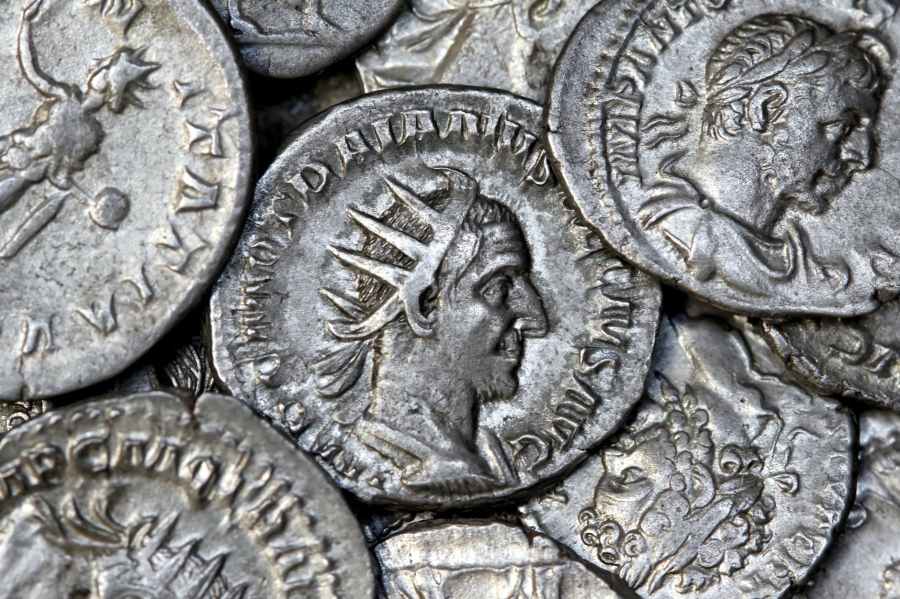
One of my favorite house rules is the Silver Standard. The concept is simple; silver pieces become the primary unit of exchange and treasure in lieu of the gold piece. There are a few other modifications required to make it work. Making a few extra tweaks to the system had some interesting and desirable effects in my games.
The first mention of silver standard being mentioned on a blog I could find was in this post on Delta’s D&D Hotspot blog in 2010. The concept was batted back and forth on the various blogs at the time. I’ll put links to some of the other posts I was able to dig up.

What’s wrong with the gold standard?
Nothing if that’s what you want to do. The game has been played that way for a long time and many like it. I don’t for a couple of reasons.
The as written gold piece system makes copper and silver less important at low levels. In my experience, most players totally ignore copper, even at first level. At higher levels, silver is barely worth the effort when working on the gold standard and being strict about encumbrance. If I can carry 1,000 coins out, why bother with anything that isn’t high value like jewelry, gems or gold pieces? As a player, it is an obvious choice, which means it isn’t a choice at all.
If my choice is get 1000 XP or get 100 XP for the same encumbrance and effort then there is no real choice. The 1000 CP is set dressing not something any player would carry away. A game master placing silver pieces or copper pieces in a gold standard system is pointless. I suppose PCs could let their hirelings and henchmen take any copper or silver the party would otherwise leave behind so long as they are carrying their load.
I want money to remain a concern no matter what level the players achieve. Reducing treasure by a 10 X while keeping level progression the same helps in that area. With a gold standard, PCs walk around the setting giving inn keepers a pile of gold as an afterthought. I consider adventurers the rock stars of the fantasy world, which means that they have money and spread it around to the peasants. I also want money to be a limited if somewhat abundant resource.
Experience Points and Leveling
Since 1 GP = 1 XP, messing with the money system has obvious impacts on experience points.
Most referees using the silver standard change it over to 1 SP = 1 XP.
Switching to 1SP = 1 XP creates the issue of how much treasure to place in an adventure. You can swap the gold piece values for silver piece values or reduce treasure by a decimal point. If you use the random treasure tables knock a zero off the coin value of the treasure.

Encumbrance
I dislike the coin weight in the original game. I’m sure there were reasons Gary thought it worked or he preferred it. I don’t care for it and find it silly to limit the amount of coins a character can carry that way. There are enough other reasons why you might not want to carry 10,000 silver pieces in your gear that I don’t see a need.
I’ve used the LotFP slot system and Dan’s stone system. They work, as does any encumberance system, if you are disciplined and consistent. I struggle with that part.
My default is the, “Let me see your character sheet. How are you carrying a full pack of gear, a heavy crossbow, three swords, a pole axe, plate armor, a shield, and 5,000 SP? You are encumbered and your movement rate is 3.” system.
A common system for coin encumbrance is 100 coins = 1 lb. That would make the coins weigh more than double what they weighed in reality but makes the book keeping easier.
I go with 200 per pound which gets us closer to actual weight of a medieval coin without making the math too annoying. For ease of play, coins all weigh the same. Sometimes I go wild and make coins minted by a certain polity worth more or less. I don’t do that often because it creates more book keeping and more complication for little benefit.
One of the arguments for a 10 coins = 1 lb system from AD&D is that it limits the amount of treasure PCs can carry and acts as a forcing function on resource management and movement speed. That’s not appealing to me. If I want to create a dilemma about what treasure to carry out, I make the treasure very valuable, bulky, awkward, sometimes fragile, dangerous, or otherwise not easy to carry out of the adventure site. This creates other questions and possibilities.
Do we bring hirelings? How many? What about a cart? Horses? Mules? Shovels? Pry bars? How much rope? That monster is worth 2000 gold to the keeper of the emperor’s menagerie. Can we capture it and keep it alive for a week? Could we take that huge copper door off the hinges and carry it out of here if we had six hirelings, some rollers, and a bucket of lard? How much noise would that make?

Pricing
Some referees change GP values to SP values. A simple conversion is dividing by 10.
I have had good results with keeping the prices unchanged. With silver standard and leaving the book prices as they are, a low level party has to make more strategic choices when they buy gear, weapons and armor.
Personally, I like what this brings to the game. It makes treasure more meaningful and a resource that is more carefully husbanded even after players make a big score.
For several years now, I’ve been using Robert Conley’s (Bat in the Attic Games) price lists. They are comprehensive, in a SP standard and fit the aesthetic I’m looking for. He has done great work with his Majestic Fantasy variants for Swords & Wizardry. I use a lot of his stuff in my games.
Starting Money
The standard method for starting money determination is 3D6 X 10 in GP. If you convert GP to SP on the price list, these are equivalent and players will be able to buy the same gear they would have if you stay with the gold piece standard.
There are several reasons why you might want to use a different method for starting money. Simplicity, speed of character generation, aesthetics of the campaign, and providing incentives for adventuring are just some of the possibilities.
The OSR has come up with tables and mechanisms for starting gear/money generation where players all get basic equipment, a choice between a couple of different basic weapons, and dicing for a small amount of spending money. A few games have random equipment generation. You roll dice and the result on the table is what you get. These systems have the advantage of greatly speeding up what is often the most time consuming part of character creation.
If you prefer to let players select their own gear and keep the prices the same, then things get a little more interesting. 3D6 X 10 in silver pieces using the prices based on gold pieces produces some very impoverished and desperate 1st level adventurers. No single character will have enough money to buy a full set of adventuring gear. They might have to choose between weapons or armor but not both. Players may want to coordinate what each party member buys. In certain circumstances, this produces some very entertaining outcomes.
In Dragon’s Bend, the first “adventure” was graverobbing at a nearby battle site due to their poverty.

Money house rules in brief.
Silver standard. Most transactions with NPCs in silver pieces or copper pieces. Gold is used by wealthy merchants, high ranking temple priests, aristocrats, and successful adventurers.
Pricelists from Majestic Fantasy by Robert Conley
1 silver piece in value returned to civilization = 1 experience point
Starting Money: Campaign dependent, Standard is 3D6 X 10 Silver pieces
Exchange Rates: 1 GP = 10 SP = 100 CP (Note: I am considering making copper more valuable my next campaign)
Encumbrance: All coins weigh the same: 200 coins / lb
Silver Standard essays from other bloggers
I’m collecting blog posts about the silver standard here. If you wrote one or have have a favorite you think I should add, drop it in the comments.
Methods & Madness: This is what inspired me to write out my house rules. Low Fantasy Silver Standard and an older post with a few links. Both are worth reading. The WEIGHT of GOLD – is OD&D right again?
Delta’s D&D Hotspot: On Money Money Results The comments section is worth reading in these posts. The OSR circa 2010 did most of its discussion on blogs and in the comments of blogs. When Google+ became popular, comment blocks became inactive and never returned after the demise of G+.
Bat in the Attic: Silver Standard Rob explains some of his thinking and sources for his excellent price lists.
Society of the Torch Pole and Rope: Using the Silver Standard Not much in the post but good conversation in the comments.
Save Vs. Wands: Why a Silver Standard?
Follow Me and Die: Gold VS Silver Standard
Middenmurk: Goes one more step toward gritty and grim with The Copper Standard Have I mentioned how great OSR blog comments used to be?
Post from the Candlekeep forum: The Turnip Economy (originally a post on a Paizo forum that I didn’t bother to look up)
 Grumpy Wizard
Dragon Magazine 74 had an article about the silver standard.
Click to access Drmg074.pdf
LikeLiked by 1 person
Pingback: Why Do Gaming Grognards’ Love History? – Grumpy Wizard
Pingback: Drifting deep into my houserules and blogs that made them! – VDonnut Valley