
Previously, I wrote about how a game is a model that answers questions.
I didn’t talk about story or storytelling. I presented role-playing games as a sort of simulation or model. The players and game master asks questions and the system produces a result.
This approach might seem lifeless if you feel that game mastering is about telling stories and role-playing games are a form of collaborative storytelling.
I tell stories with my games. The stories I tell are about the non-player characters and the things that happened before the game starts.
I reveal pieces of those stories with embedded narrative and micro-exposition so that the players can put them together and discover them as the game progresses.
Those stories of the game world and its NPCs are the game state at the beginning of the adventure.

Combining the skills of storytelling and “game state” mindset produces the kinds of game experiences that I enjoy the most.
Games and stories answer questions, but they do it in a different way.
A great storyteller is good at noticing things. They notice things about people, our relationships, our tendency to do stupid things, our best moments, and our worst. They notice that if you behave a certain way in a certain kind of situation there are patterns to the outcomes.
History never repeats itself, but it does often rhyme.
Mark Twain
The great storytellers are good at devising stories which demonstrate the thing they noticed so the rest of us mere mortals see it and say, “Ahh yes, you are right.”
What happens when you seek revenge without concern for other people and their needs?
Hamlet.
When he wrote the play, Billy did two things.
- Told an entertaining story.
- Make a point about human behavior.
He asked a question and gives an answer.
The events that happened in the story and their outcome had to be what they were. Otherwise, the thing that Bill was trying to say would not have been said.
If Hamlet doesn’t kill Polonius, drive Ophelia insane, leave Rosencrantz and Guildenstern to die and poison his mother then the message, “the revenge seeker not only destroys his enemy but himself and his loved ones,” would not be communicated.
If Hamlet misses his attack roll and Polonius escapes, If Ophelia makes her saving throw, if Rosencrantz and Guildenstern succeed in a persuasion check; then the events lead to an entirely different thematic outcome. They must happen the way they happen for Hamlet to have the meaning Shakespeare wanted it to have.
The storyteller is the author of the answer to the dramatic question of a story.
Why games and stories are different.
Let’s look at what game developer Jonathon Blow said about the answers that games produce the question of “What happens?” when a player makes a choice.
“What’s important is that those answers were not authored by me. They were generated by a system corresponding to the questions that I asked.”
This is crucial, “…those answers were not authored by me.”
The players make a choice which leads to a question, “What happens?”
The game provides the answer. Not the game master. Not the game designer.
The game master applies the rules and procedures of the game, rolls dice if necessary, interprets the outcomes or makes an adjudication if the rules and procedures of the game are inadequate.
The game master tells the players the outcome.
Any theme or meaning to be found in that event emerges from the choices of players and the outcomes the system produces.
Approaching the Truth
Fiction is the lie that tells the truth.
Neil Gaiman- Art Matters: Because Your Imagination Can Change the World
Jonathon Blow noted in his keynote speech Truth in Gaming, that games can do something interesting. When you incorporate fundamental properties of the universe into your games, the answers the game produces something that we might call, the Truth.
Great stories tell the Truth. We read, listen to, or watch a story and know in our guts the Truth the storyteller has observed. Racism is wrong. Be kind because you don’t know what the other guy is going through. Working together produces bigger results than working alone.
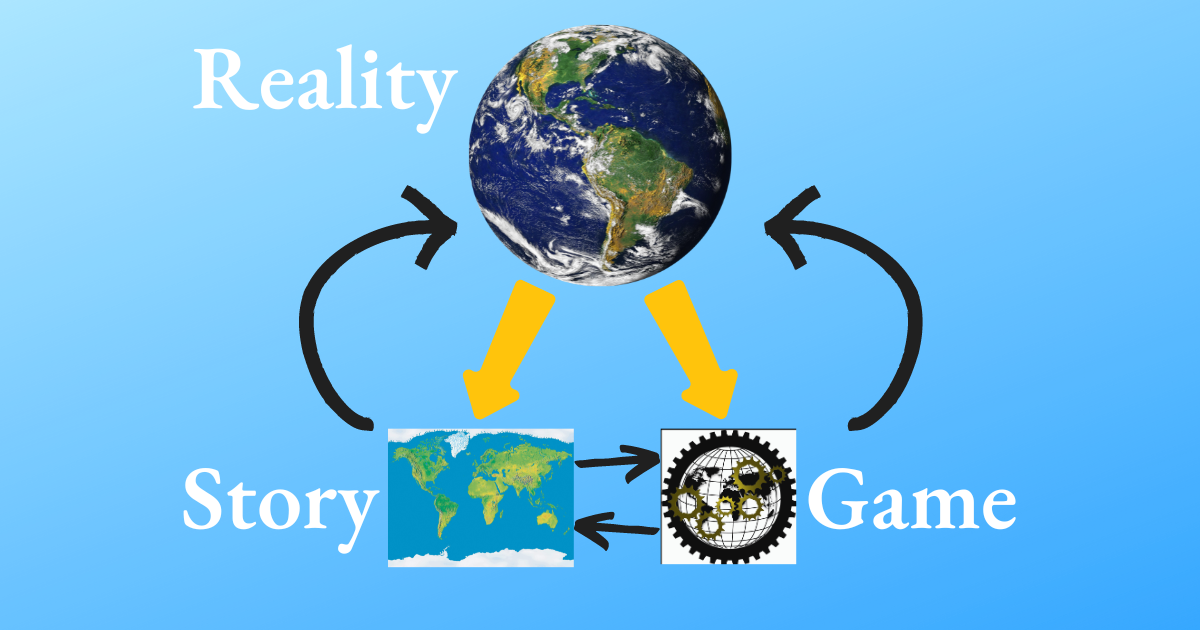
What has the storyteller observed? The universe we live in doing its thing. The state of the world, the actions of people, and the way the world responds. The storyteller then reports on the state of the world in the form of a made up story. It is a lie that tells the Truth.
What, as players of games are we observing? A model of a world, that has fundamental elements of our universe built into it. A made up world, with rules that are similar to our own world. The game master tell the players the state of the game world, the players take actions, the game world responds. The game master reports the state of the game world in the form of a description.
A great game arrives at some of the same Truths the storyteller observes because they are both based on the fundamental Truths of the universe where we live.
If the game is built on that model and we are open to the answers it provides, we learn some Truth from the lie of the game world.
Summing up…
My games have stories but those stories occur before the players sit down at the table. They are the game state at the beginning of the game. The stories provide context to the game state so that players have the information they need to make choices that are most likely to succeed in the pursuit of their objectives.
The players decide what they want to do. The game decides what happens. I report back using the skills of storytelling because we are people and narrative is how we communicate.
I’m not telling them a story that I have authored. I’m reporting the game state in story form.
Games answer questions.
I get the most enjoyment from game mastering when I accept the answer the game produces and only make rulings when I have to.
When the players and I are open to the answers the game produces, we can observe and learn some Truth about ourselves, each other, and the universe we live in.
 Grumpy Wizard
Past attempts to create a Theory of RPGs have always been disappointing because the subject is too broad and the question too vague.
But I think there might be something valuable to gain by giving this specific style of how to approach playing an RPG and how to conceptualize what an RPG is a name and an identity. This very much aligns with all the things I’ve worked out for myself since reading Gus L’s All Dead Generations on classic dungeon crawling.
I don’t think any of us are having any spectacular new or innovative ideas. It’s a concept that already exists as a thing in the wild and probably has for a very long time. If we had a name for it, we could write things specifically about it without involving all the other things that are thrown into the very big box of “RPGs”.
“XYZ is all about making decisions and dealing with the consequences of your actions.” is a statement that I think a lot of people with similar ideas and preferences would agree with. Though it’s still distinctively different from Simulationism, which carries the implication of highly detailed granularity and rigid mechanics.
LikeLiked by 1 person
It is curious to me how in many ways TTRPG theories lack substance and practical implementation value. I’ve been dipping into some of the professional literature of video game design and narrative design. It is far more advanced and frankly more useful to me than most everything I’ve read in TTRPG design. A lot of it actually applies to TTRPGs too.
“I don’t think any of us are having any spectacular new or innovative ideas.”
This is super important. When I finished reading _The Elusive Shift_ I thought to myself, “I have never had an original thought about RPGs in my life.” Greg Stafford, Greg Costikyan, Erik Wujcik and others had most of what we discuss online figured out by 1980. Much of it was lost or forgotten because it was printed in an obscure zine printed on a mimeograph machine.
I find that reading a different person’s perspective sometimes helps an idea click in my mind. Also, there is always a churn of people leaving and new people joining the hobby. Sometimes it’s easy to forget that there are people who have never seen any of this stuff before. I hope some of what I have to say is helping people who haven’t been exposed to these ideas before or they haven’t made sense to get something from my writing.
Thank you for your thoughtful comment. I appreciate that you took the time.
LikeLiked by 1 person
Do you have some game design / narrative design books to recommend? I’d not found a lot of value in them but it’s been a while since I’ve read any, and I wasn’t actively DMing at the time.
LikeLiked by 1 person
_Game Writing: Narrative Skills for Videogames_ edited by Chris Bateman is a good overview. It’s basically a text book for people studying game writing for video games. It brings up a lot of the complicated problems of creating narratives for games.
_Game Design_ by Lew Pulsipher is OK but it is focused mostly on board games. It does have some RPG stuff in it.
Greg Costikyan has a lot of interesting things to say. His book is on my list of things to read but haven’t picked up yet. http://www.costik.com/writing.html
I like _Arbiter of Worlds_ by Alexander Macris quite a bit- He’s has an interesting series of YouTube videos that I mostly agree with but disagree with in a few spots here and there. https://www.youtube.com/@AlexanderMacris
Justin Alexander has a new book out, I haven’t read it yet. I like his website quite a bit and recommend his game mastering 101 page. I suspect the book is basically the same information presented in a more concise book form. https://thealexandrian.net/gamemastery-101
For learning about story, I really like the Film Courage YouTube channel. I link to videos from them on my blog posts from time to time.
A lot of my ideas about game and and narrative design are bits and pieces of things I’ve accumulated from blog posts, scholarly journal articles, essays, books purely on storytelling in one form or another, and my own personal experiences and integrated together.
Is there is a specific area or specific concept that you are looking to learn more about?
LikeLike
Pingback: Emotion Fuels the “RPGs are Stories” Myth – Grumpy Wizard
Pingback: “Sandbox vs. Railroad” Is a False Dichotomy – Grumpy Wizard
Pingback: The Basic Structures That Role-Playing Games and Stories Have In Common – Grumpy Wizard
Pingback: Why I Read the “What is an RPG?” Section Of an RPG Book – Grumpy Wizard
Pingback: Musings About the Emotional Arc of My Sandbox Campaigns – Grumpy Wizard